A table left empty at 7 pm cannot be sold tomorrow. Restaurant marketing therefore needs a clear commercial purpose: reach the right guests at the right time, answer the questions that shape their decision and make booking straightforward. Using a fictional restaurant in Lucerne, this guide explains how SEO, GEO, a documented audit and twelve months of implementation fit together — including the question of whether the investment makes financial sense.
By Kacper Ruta · GlasBox — SEO & GEO Agency · Reference date: 7 September 2026.
Illustrative case: “Restaurant LUMEN” is an entirely fictional restaurant in Lucerne. Its operating figures, audit findings, AI observations and calculations are teaching assumptions. They are not client results, industry benchmarks or forecasts. The title image supplied by GlasBox illustrates the topic; it does not document a client project for the fictional model restaurant.

01 — Your marketing starts with the empty table
Tuesday, 6.20 pm. The kitchen is ready, the service team is prepared and some tables remain empty. At the same time, someone is looking for an easy dinner on their phone. An assistant is organising a company meal. A couple is asking an AI service where to eat before a concert.
These people have different questions. One wants to book immediately. Another needs space for twelve, a clear menu proposal and a quotation. The couple needs to know whether dinner and the journey to the concert will fit their schedule. An attractive homepage alone rarely answers all of this.
My starting point at GlasBox is an operating question: which services, occasions and guest groups should become better occupied? Only then do we discuss search terms, content and technology. An additional guest on a quiet Tuesday can be commercially valuable. Another enquiry for an already fully booked Saturday may simply create more work.
The decisions that matter
Establish spare capacity, contribution per guest and the booking journey first.
Align Local SEO, the website and GEO around reliable operating information.
Judge an audit by verifiable findings and actionable recommendations.
Measure AI mentions, confirmed reservations and guests actually served separately.
Agree the annual engagement through scope, acceptance criteria and commercial review points.
02 — The model restaurant: 60 seats and a clear objective
Our fictional Restaurant LUMEN serves seasonal food in Lucerne. It has 60 indoor seats, a lunch offer and the ability to host smaller company dinners. German and English are the website’s principal languages. The existing reservation system is intended to remain in use.
The model business wants to attract more suitable guests on Tuesday to Thursday evenings. For this simplified capacity calculation, each evening has one seating of the 60 seats. Terrace seating, table turnover, blocks reserved for groups and different visit lengths are outside the model.
| Evening | Guests served in the model | Available seats | Occupancy |
|---|---|---|---|
| Tuesday | 36 | 24 | 60% |
| Wednesday | 42 | 18 | 70% |
| Thursday | 48 | 12 | 80% |
| Friday | 58 | 2 | 96.7% |
| Saturday | 60 | 0 | 100% |
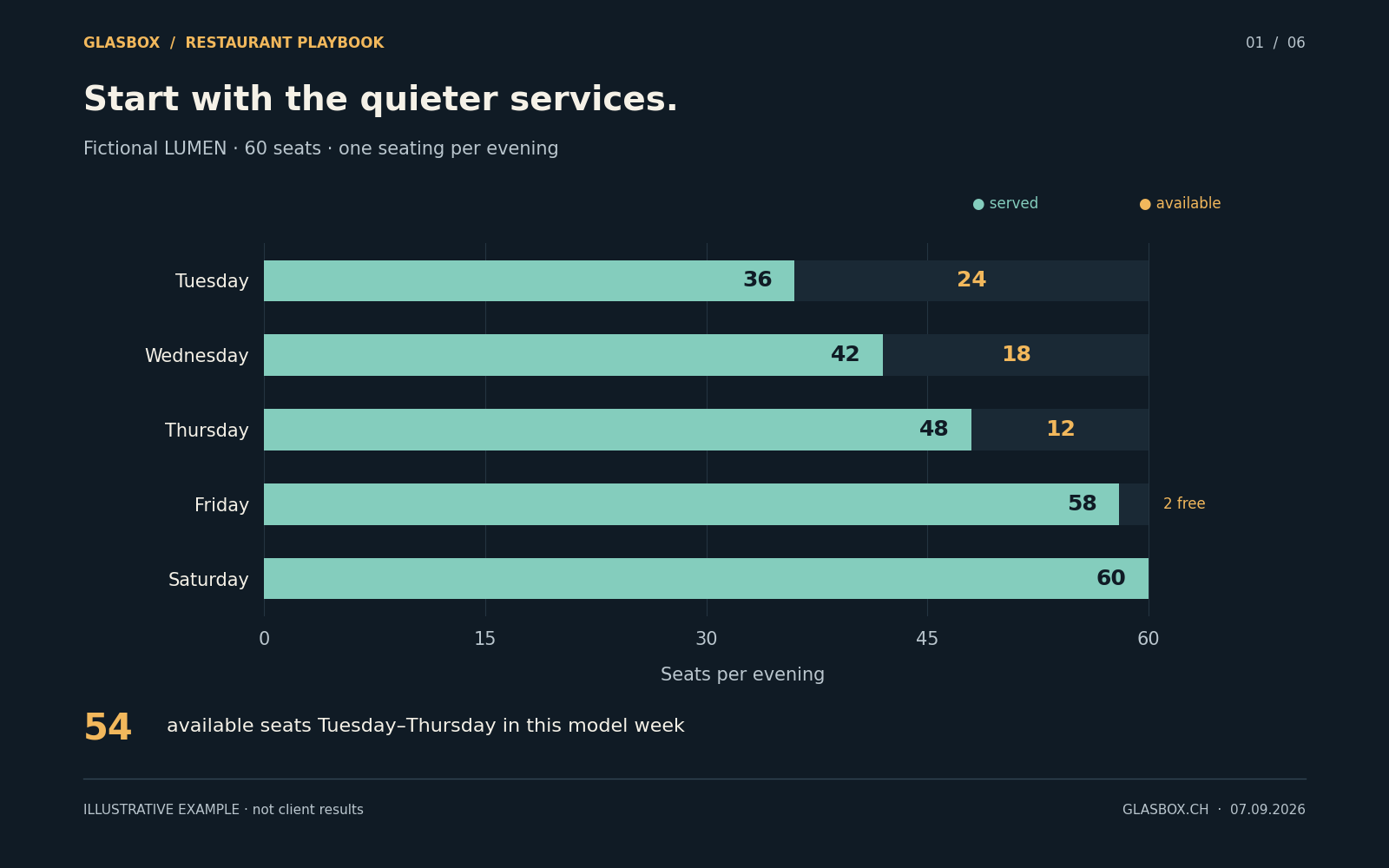
The 54 available seats from Tuesday to Thursday represent capacity in this hypothetical week. They do not demonstrate additional demand. The audit must establish whether relevant searches exist, whether the offer is convincing and whether suitable guests can be acquired on economically sensible terms.
This gives management a specific brief: develop profitable additional visits during quieter services and make company dining enquiries easier for the team to handle.
03 — What an additional guest needs to contribute
A marketing budget should fit the restaurant’s economics. Subtracting food costs alone from revenue is insufficient. Additional staffing, payment fees, variable booking charges and other costs caused by the visit also belong in the calculation.
The model assumes CHF 70 net revenue and CHF 35 incremental variable costs per additional guest. That leaves CHF 35 contribution before marketing and unchanged fixed costs. This is an assumption, not a typical Lucerne restaurant margin. If extra guests require another shift or other step costs, the calculation must change.
Two possible budget routes
For orientation, we use GlasBox’s published implementation starting price of CHF 1'500 per month. A separately commissioned SOURCE/01 Full costs CHF 2'450 once. The actual proposal determines scope and combination; a separate Full Audit is not automatically added to every engagement. GlasBox Studio is not registered for Swiss VAT.
| Simplified budget case | Calculation | First-year fees |
|---|---|---|
| Twelve months at the monthly starting price | 12 × CHF 1'500 | CHF 18'000 |
| Separate Full Audit plus twelve months at the starting price | CHF 2'450 + 12 × CHF 1'500 | CHF 20'450 |
These are fee floors for the stated combination at the starting price, not a fixed quotation covering every action in this guide. Advertising spend, external software, photography, a substantial website rebuild and optional integrations are excluded. A larger commissioned scope increases the economic threshold.
Break-even as a decision aid
Additional guests required = actual project costs ÷ incremental contribution per guest. The model with the separate audit gives CHF 20'450 ÷ CHF 35 = 584.29. Rounded up to whole people, 585 additional guests served in the year are required to cover this fee alone. That is approximately 49 guests per month averaged across the year.
| Contribution per additional guest | Additional annual guests at CHF 20'450 | Monthly average, rounded up |
|---|---|---|
| CHF 20 | 1'023 | 86 |
| CHF 35 | 585 | 49 |
| CHF 50 | 409 | 35 |
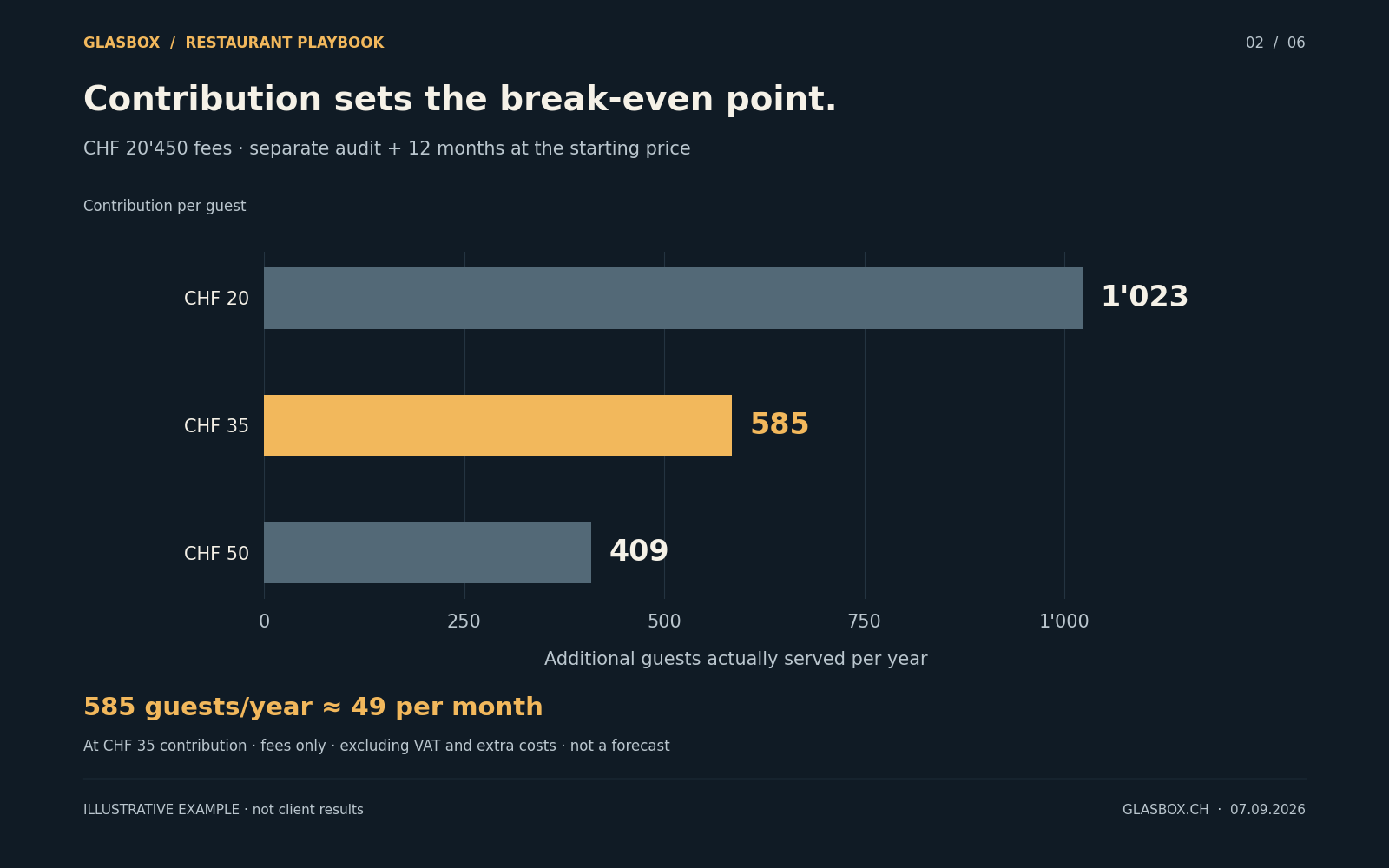
This figure is neither a monthly performance promise nor evidence of incremental business. If the first quarter produces few additional visits, later periods must contribute more to reach the annual threshold. Moving reservations from a platform to the restaurant’s website does not itself create new guests: initially, the relevant benefit is the actual fee saving, less the costs of the direct channel.
Returning guests can increase the value of an acquisition. We include repeat visits in planning when the restaurant’s own evidence supports them. Assuming four future visits from everyone can improve a spreadsheet without filling a single table.
04 — SEO, Local SEO and GEO in the same dining decision
SEO provides foundations that help search engines discover and interpret relevant pages. Local SEO clarifies the local business: what kind of restaurant it is, where it is, when it opens and which visits it suits. GEO extends the work to generative answer systems: is the restaurant mentioned, described accurately and supported by relevant sources?
| Area | A guest’s question | Our working question |
|---|---|---|
| Traditional search | “vegetarian lunch Lucerne” | Is there an accessible, relevant page with the current offer? |
| Google Maps | “restaurant near me” | Are location, category, hours and booking destination correct? |
| AI search | “Where can we have an early dinner before a concert in Lucerne?” | Are the conditions that matter publicly verifiable? |
| Booking | “Do you have space for four on Thursday at 6 pm?” | Can the guest check availability and make a confirmed booking? |
Google states that its AI search features continue to rely on SEO fundamentals. They require no additional special file or AI-specific schema. A supporting page must, among other conditions, be indexed and eligible to appear with a snippet. Appearance remains uncertain even when requirements are met.
For LUMEN, we would first describe the conditions for a visit clearly. GEO work then examines that information through realistic guest questions, addresses gaps and repeatedly checks the answers observed.
05 — How a GlasBox restaurant audit works
A useful audit connects publicly visible information with what actually happens in the business. Looking at a website cannot establish reliable reservation revenue. Without authorised access, internal metrics remain unknown and must be labelled accordingly.
The briefing comes before the investigation
We begin with the food offer, service times, capacity and priorities. Which days need to grow? How large are typical groups? Which enquiries are unsuitable? Who can approve content, opening hours and prices? Are there seasonal closures? Which languages can the restaurant actually support in service and communication?
The free preliminary analysis accompanying an individual proposal uses this briefing and public information. Following contract agreement and authorised access, the investigation is deepened within the commissioned scope. A separately purchased Full Audit is its own engagement. Access should be shared through appropriate permissions; personal passwords do not belong in an email thread.
Seven areas and one actionable plan
| Audit area | What we would examine | Concrete output |
|---|---|---|
| Business logic | Capacity, occasions, contribution and enquiry handling | Commercial objective and priority services |
| Discoverability | Status codes, indexability, links and language pages | Technical findings tied to specific URLs |
| Local identity | Website, Business Profile and relevant directories | Reconciliation of essential business information |
| Decision content | Menu, cuisine, groups, directions, prices and special hours | Content gaps ranked by booking relevance |
| Booking journey | Mobile use, provider handoff, errors and confirmation | Documented functional tests |
| AI observation | Repeatable guest questions, answers and sources | Baseline with context and limitations |
| Measurement and operations | Authorised data access, events and ownership | Measurement plan, priorities and acceptance criteria |
The technology behind the work
A crawler can collect accessible pages, links, redirects and metadata. Search Console and the Business Profile provide additional views when authorised access is available. PageSpeed Insights and browser tools help diagnose technical issues. A real booking test establishes whether a guest can complete the process. AI questions use permitted, available interfaces or APIs with their context recorded.
These tools produce different observations. A language model can help summarise them; a claim such as “the booking button does not work” requires a reproducible test. Missing information receives an “unverifiable with available access” status. It is not replaced with estimated results.
Each finding records at least the page or system, date, method, observation, possible impact, recommended change, owner and acceptance criterion. This turns “your website could improve” into work management can approve and a developer can finish.
06 — A sample audit: five findings and five decisions
The following findings are entirely constructed. No real Restaurant LUMEN was examined. They illustrate the standard an audit should meet and how we would justify the order of work.
| Illustrative finding | Commercial relevance | Priority and action | Acceptance |
|---|---|---|---|
| An overlay covers the booking button in a mobile layout | A guest ready to book cannot continue | P1: remove obstruction and check keyboard use | Test booking completed on agreed devices |
| Kitchen hours are missing and special hours conflict | Uncertainty before a time-sensitive visit | P1: establish an approved source for service times | Website and relevant profiles agree |
| The menu is only a difficult-to-read image | Dishes and prices are hard to compare on mobile | P1: accessible HTML menu; optional PDF | Menu is readable on mobile and present in delivered text |
| No company dining page | Qualifying questions arrive individually with the service team | P2: publish a group offer and enquiry journey | Test enquiry provides sufficient information to proceed |
| Clicking “Book” is counted as a completed reservation | Management overestimates booking success | P1: separate start, confirmation and attendance | Test cases appear once in the appropriate status |
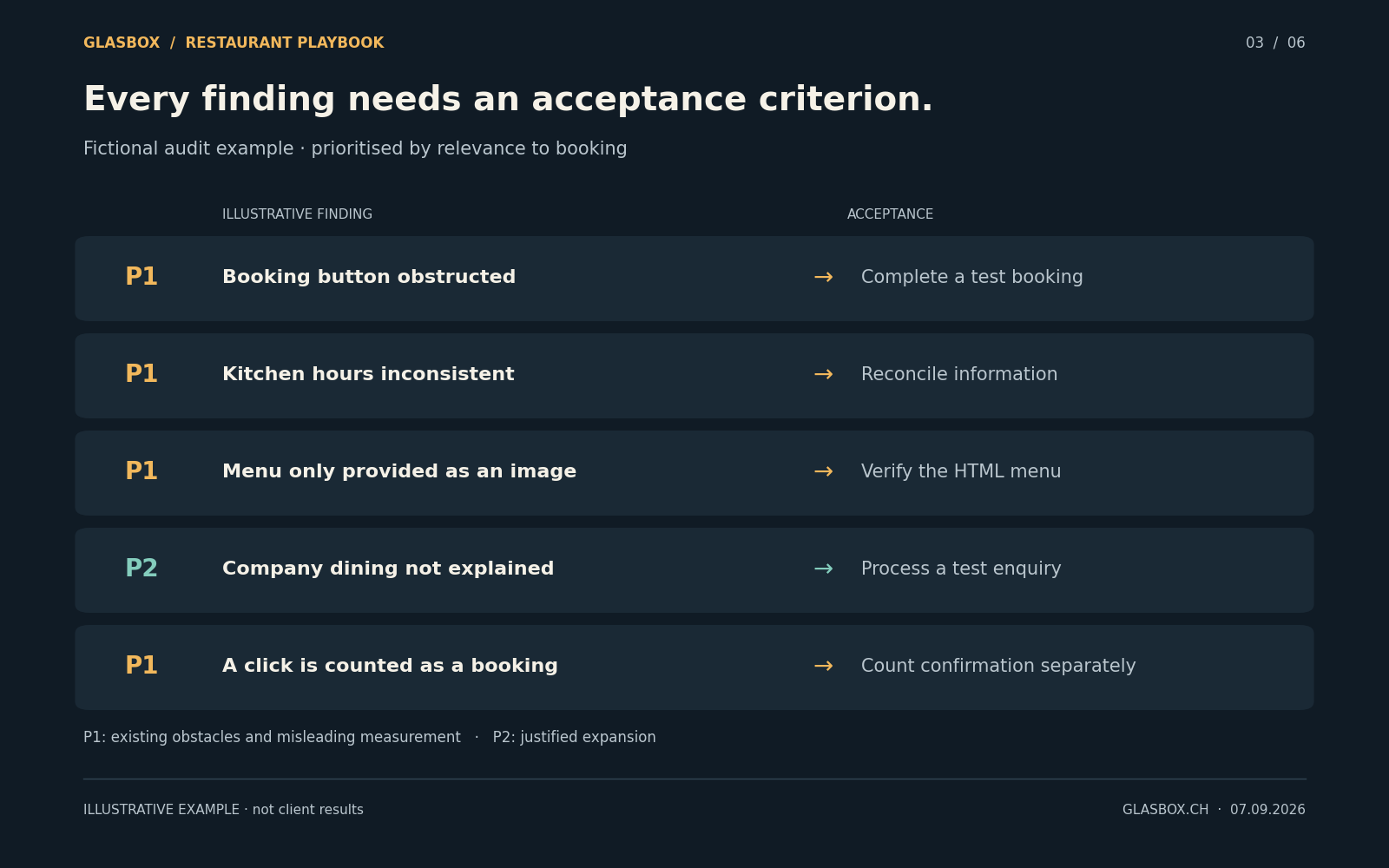
P1 here means addressing an obstacle in an existing decision or misleading measurement first. P2 means scheduling a justified expansion afterwards. This is a proposed working model, not a universal SEO standard.
Technical acceptance proves that a defined function or information item has improved. Subsequent operating data must establish whether more visits follow. A repaired booking process is verifiable; “20% more guests” without supporting evidence would be a fabricated success story.
07 — The search questions that matter in Lucerne
We would organise research around dining occasions. The phrases below are starting ideas for validation, not measured keywords or a search-volume report. Priorities follow available search data, the actual offer and restaurant capacity.
| Dining occasion | DE-CH examples | English examples | Suitable destination |
|---|---|---|---|
| Working-day lunch | Mittagstisch Luzern; Business Lunch Luzern | business lunch Lucerne | Lunch page with days, hours and current menu |
| Choosing dinner | saisonale Küche Luzern; Restaurant Luzern reservieren | seasonal restaurant Lucerne; book dinner Lucerne | Cuisine, menu, prices and direct booking |
| Before an event | Essen vor Konzert Luzern | dinner before concert Lucerne | Early kitchen service and verified directions |
| Organising a company meal | Firmenessen Luzern; Restaurant Gruppe Luzern | team dinner Lucerne; group dining Lucerne | Group offer with capacity and enquiry process |
| Dietary preference | vegetarisches Restaurant Luzern | vegetarian options Lucerne | Actual dishes and current information |
| Checking a specific business | LUMEN Öffnungszeiten; LUMEN Speisekarte | LUMEN opening hours; LUMEN menu | Maintained operating information |
Lucerne and Luzern belong in the appropriate language version. We use Swiss High German for German-speaking readers and clear English for international guests. French or Italian are further options when demand and maintenance capacity justify them. Four poorly maintained language versions help nobody.
Lucerne Tourism publishes a restaurant guide. The KKL explicitly connects dining with concert and event visits. These are useful starting points for research, not evidence of demand for LUMEN or of a partnership with those organisations.
A page claiming “restaurant near the KKL” makes sense only when the location and journey support it. Invented walking times, an inaccurate lake-view claim and duplicated location pages for Kriens, Horw, Emmen or Malters create false expectations. One real location needs a clear local identity.
08 — Local SEO: the first impression often happens off your website
Google identifies relevance, distance and prominence as principal factors in local results. Complete, accurate business information helps it understand the business. Website optimisation cannot remove the distance from the searcher, and better local placement cannot be purchased from Google.
Our proposed maintenance process for LUMEN starts with an approved record: actual business name, address, phone, primary category, website, booking destination, opening hours, kitchen hours and verified amenities. Accessibility, terrace seating, vegetarian choices and group facilities are published only after the responsible person has checked them.
Special hours need their own process. Before holidays, closures and events, the restaurant confirms its schedule and a named person updates the website and relevant profiles. The menu also needs an owner and an update routine. An old price is not a minor editorial detail when a guest is deciding where to eat.
Reviews without vouchers or pressure
Genuine reviews help guests make decisions. Google prohibits incentives such as discounts, payments or free services for reviews, and selectively requesting only positive reviews. We recommend a neutral, voluntary invitation after the visit, without specifying stars, wording or staff names, and without pressure to post immediately at the venue.
A suitable invitation could read: “Thank you for visiting. If you would like to, please share your experience through our review link. Your honest feedback helps us and future guests.” Whether that invitation may be sent by message must be assessed within the intended communication process. A reservation does not automatically become a newsletter subscription.
Responses to criticism should remain calm, specific and discreet. Guest data, internal discussions and reservation details do not belong in public replies. A practical offer to resolve the matter directly serves the restaurant better than an extended argument.
09 — The restaurant website as a dependable booking journey
A guest on a phone should quickly understand the cuisine, likely spending level, kitchen hours, location and reservation options. These questions form the information architecture.
A practical core for LUMEN
Homepage with clear cuisine, location and a visible reservation action.
Readable HTML menu with current prices; PDF as an additional option.
Lunch offer with validity period, days and service times.
Company dining information with group sizes, menu approach, conditions and enquiry route.
Contact and directions with verified details and distinct opening and kitchen hours.
Equivalent English core pages and appropriate booking destinations.
Not every area necessarily needs a separate URL. A small website can remain compact. Dedicated pages are useful when an occasion needs distinct information and a clear next action. Navigation should support decisions rather than become an SEO directory.
What we would verify technically
The reservation action remains accessible on a narrow screen. Forms have visible labels, understandable errors and usable keyboard navigation. Handoff to an external booking provider reaches the right language and restaurant. Test cases cover available and unavailable times, a failed request and confirmation.
Essential information should be delivered as text. Checks include successful page responses, accidental noindex, appropriate canonicals, internal links and a sitemap. Language versions receive corresponding reciprocal hreflang references; the English page should not simply canonicalise to German.
For speed, real-user measurements matter where sufficient data exists. Good Core Web Vitals thresholds are LCP at or below 2.5 seconds, INP at or below 200 milliseconds and CLS at or below 0.1, assessed at the 75th percentile. A single Lighthouse run is a laboratory measurement and does not replace field data. Missing field data is reported as missing.
Structured data with clear boundaries
On the real restaurant website, Restaurant markup can describe verified details such as name, address, cuisine, hours, menu URL and reservation destination. Those details must match visible content. A booking URL in markup does not create a booking integration or guarantee a special search appearance.
Reviews of a business on its own website are ineligible for Google’s self-serving LocalBusiness review-star feature. Adding a review widget does not remove that restriction. No real restaurant listing is created for this fictional editorial example.
10 — GEO starts with an answer a guest can use
Consider the question: “Where can we eat early in Lucerne before a concert, with vegetarian options?” An answer system can point to verifiable conditions only when they are described reliably somewhere. A general declaration of passion for food provides little substance.
Turning vague promotion into useful information
Vague sample wording: “Experience culinary highlights in a unique setting. We delight our guests with passion.”
More specific sample wording for fictional LUMEN: “Our evening kitchen opens Tuesday to Saturday at 5.30 pm. The current menu includes vegetarian main courses. If you are dining before an event, tell us your intended departure time when booking. We will confirm whether the schedule is possible that evening.”
These operating details are also invented examples. For a real restaurant, the business approves service times, dishes and commitments before publication. We would not infer table availability or a guaranteed service duration from editorial copy.
Content that supports a decision
For company dining, useful information includes minimum and maximum group sizes, room arrangements, menu choices, quotation handling, confirmation and cancellation terms. Lunch visitors need a currently valid menu, service days and timing. Guests with particular dietary needs require current information and a clear route to the responsible person.
This content helps people directly. It also creates more verifiable sources for search and answer systems. Whether a particular service subsequently mentions LUMEN remains something to observe. We promise neither “registration in ChatGPT” nor the training of external models on the restaurant.
11 — How we would observe AI visibility
One answer to “What is the best restaurant in Lucerne?” is not a market analysis. For the model, we propose a fixed panel of twelve questions: eight in German and four in English. They cover dinner, lunch, company meals, vegetarian options and pre-event dining. This is a proposed measurement design, not a completed test.
Three agreed search interfaces could be observed: ChatGPT with search active, a specifically defined Google AI search surface and Perplexity. Availability, region, language and permitted use must be checked at the time. Two runs on separate days would give 12 × 3 × 2 = 72 planned observations.
Each run records the exact question, date, time, language, stated location, interface, visible mode and sources. New conversations reduce the influence of earlier dialogue; they do not eliminate personalisation or location differences. A question containing “in Lucerne” does not establish that the search itself originated in Lucerne.
Record mentions, sources and factual quality separately
| Field | Meaning |
|---|---|
| Restaurant mentioned | The name appears in the observed answer. |
| Own website cited | The answer visibly links to a restaurant page. |
| Third-party source cited | Another website is used as supporting evidence. |
| Information correct | Relevant details match the verified business information. |
| Explicit recommendation | The restaurant is actually recommended in context. |
| Booking path present | A meaningful next step is visible. |
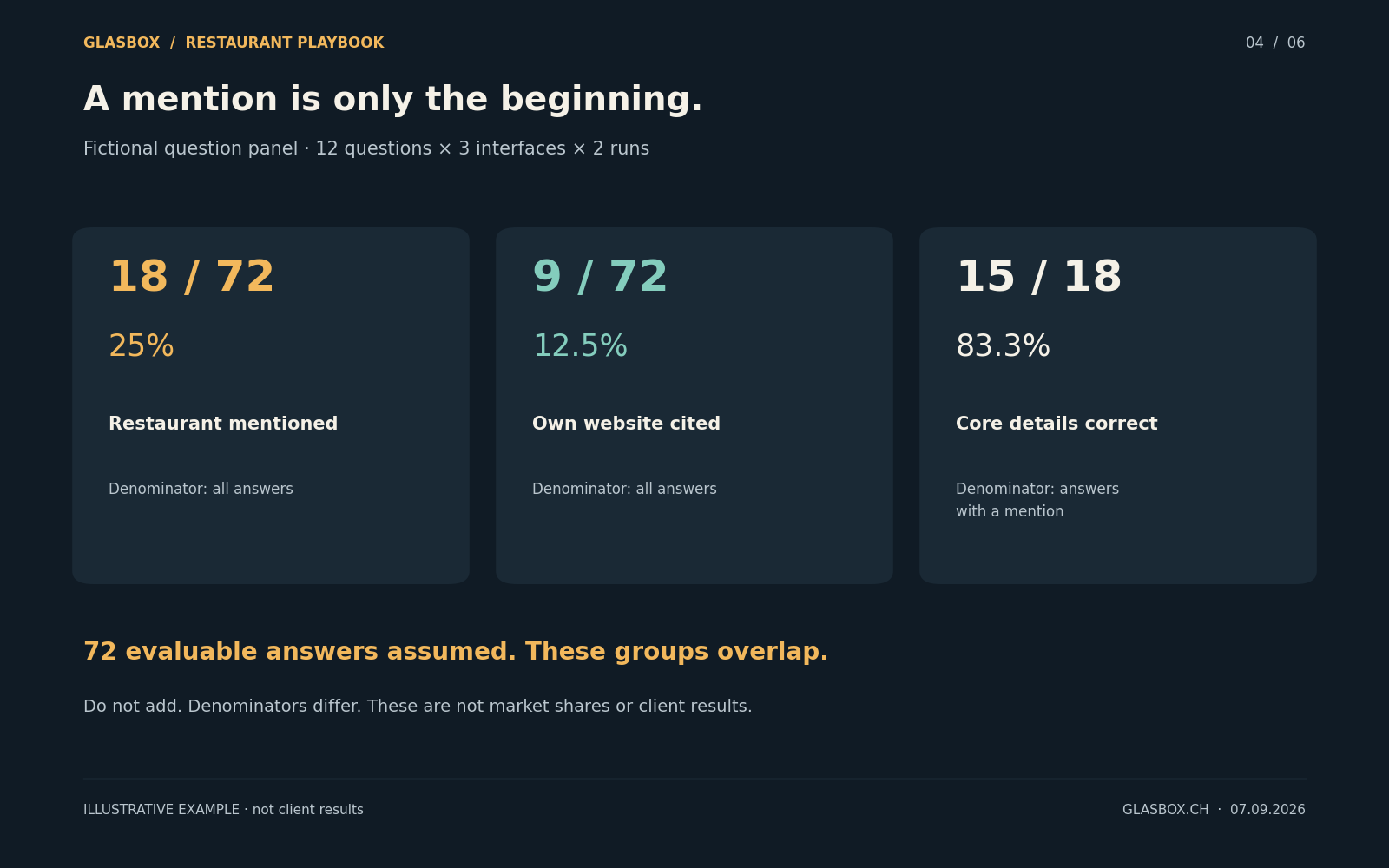
To explain the metrics, suppose all 72 answers are evaluable. Eighteen mention LUMEN: an observed mention rate of 25%. Nine cite its website: 12.5% of all 72 answers. Fifteen of the eighteen mentions have correct checked core details: 83.3% within that subset. These figures cannot be added or presented as market share; the groups overlap and denominators differ.
Failed runs remain in the record. No AI answer appearing in an available Google surface is recorded separately as “no AI answer displayed”. A technically unavailable surface is “not evaluable”. We publish the relevant denominator and compare series defined on the same basis. A changed question panel or new product surface starts an explicitly marked comparison series.
12 — Turning the audit into a credible proposal
An audit should support an investment decision. The proposal translates findings into commissionable work: which pages and systems will be addressed, what will be delivered, who supplies business information, what costs extra and when a task is accepted as complete.
GlasBox distinguishes a free short check with limited scope, a free preliminary analysis accompanying an individual proposal, the separately available SOURCE/01 Full at CHF 2'450 and implementation from CHF 1'500 per month. After agreement, the project analysis is deepened within the commissioned scope to establish the implementation baseline. It is not automatically another separately charged product.
An illustrative scope for Restaurant LUMEN
The structure below is a sample statement of work for discussion. It is not a binding GlasBox proposal or a promise that every activity is included at the monthly starting price.
| Component | What the actual proposal should specify |
|---|---|
| Objective and location | One restaurant in Lucerne; priority services and occasions |
| Data and baseline | Authorised sources, missing access, baseline and measurement definitions |
| Technical implementation | Named defects, page templates and commissioned booking-system changes |
| German and English content | Specific pages, scope, translation, approvals and revision rounds |
| Local SEO | Profiles to maintain, business details and update ownership |
| GEO observation | Agreed questions, interfaces, repetitions and report format |
| Ongoing work | Monthly prioritisation, implementation capacity and review meeting |
| Commercial terms | Fees, third-party budgets, payment schedule, duration, termination and changes |
| Handover | Account ownership, exports, documentation, code and usage rights as agreed |
For LUMEN, we would first discuss the obstructed booking action, uncertain service times and incorrect conversion measurement. A larger relaunch would be justified only if the existing site cannot economically support the necessary structure. An AI application needs its own business case.
The restaurant retains control of its accounts. Responsibilities are explicit: management for the offer and approvals, GlasBox for the agreed technical and editorial work, and the booking provider for its interface where relevant.
Where is your restaurant losing booking opportunities?
Bring your website and the services you want to fill more effectively. We will discuss the starting position and, where the project fits, prepare an individual proposal with a free preliminary analysis.
Request a proposal and preliminary analysis13 — The complete twelve-month implementation plan
This annual plan is a proposed sequence for the fictional restaurant. Month 1 starts at the agreed project commencement. Order and scope are adapted to the audit, budget, season, access and approvals. Monthly objectives are deliverables, not promised ranking or revenue increases.
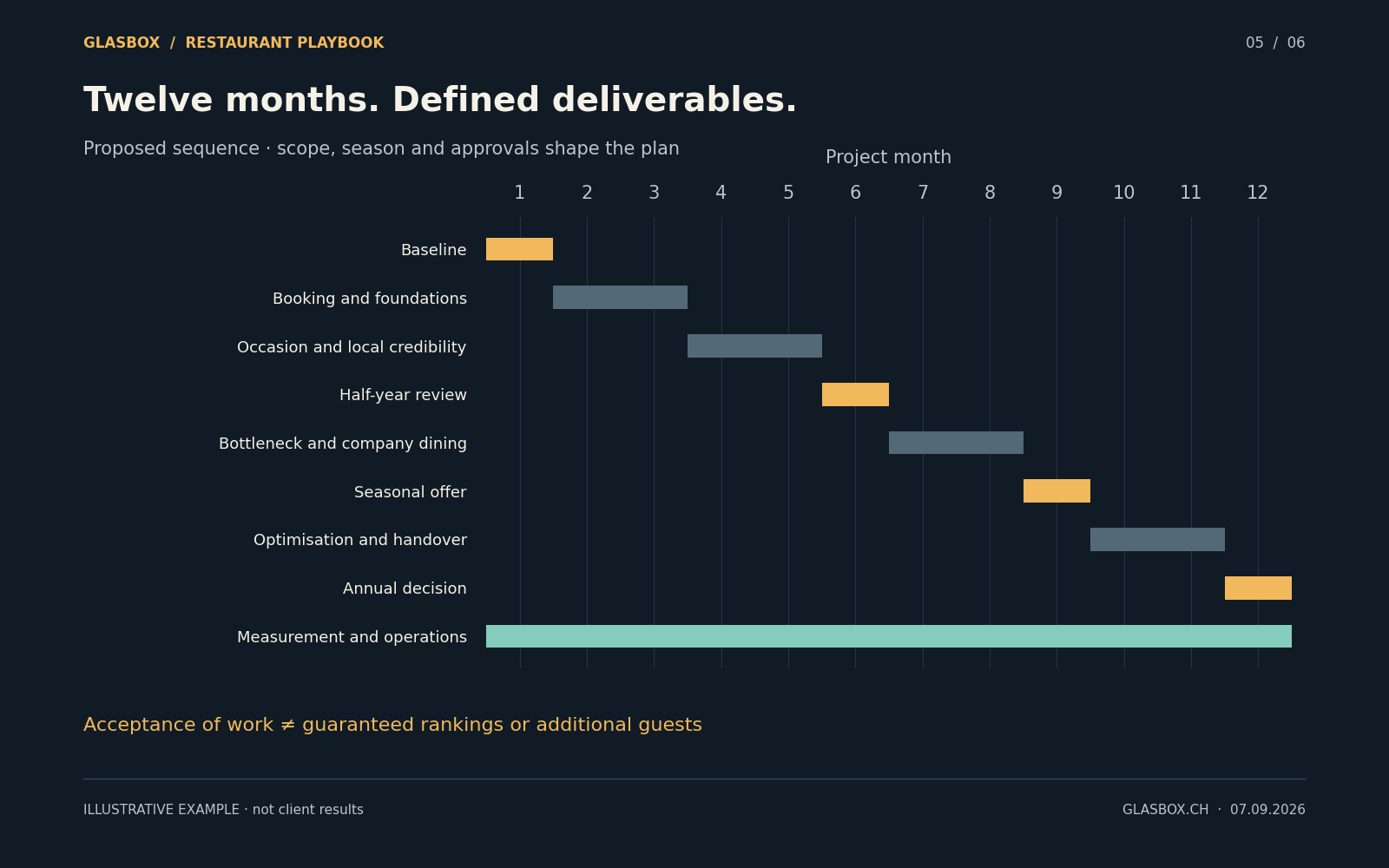
Month 1 — Establish operating priorities and the baseline
We would review existing data, define priority services and inspect authorised systems. The question panel, measurement definitions and prioritised finding register are established. Management confirms the menu, service hours, capacity and responsibilities. Where historical data is unavailable, measurement begins now.
Deliverable: an approved baseline with explicit gaps and a prioritised 90-day plan. Acceptance: management understands the starting position and can follow the reasoning behind the first tasks.
Month 2 — Repair booking, technical issues and core information
Confirmed booking obstacles come first. We would address mobile overlays, broken links, unnecessary detours and ambiguous confirmations. Essential business details are aligned in parallel. Existing URLs are retained where practical; necessary changes receive a redirect plan.
Deliverable: a documented, tested booking journey and corrected core information. Acceptance: agreed test cases pass, including a failure and an unavailable time. An Analytics click is no longer presented as a confirmed reservation.
Month 3 — Publish the essential German and English pages
The menu, lunch offer, contact and reservation information are revised within scope. English core pages contain the same essential facts. Language links, mobile readability and structured information are checked. The first 90-day meeting reviews completed work and measurement quality.
Deliverable: approved core pages with documented technical checks. Acceptance: the restaurant confirms accuracy and currency; the agreed content is accessible. Indexing is observed separately and is not assumed merely because publication occurred.
Month 4 — Develop one commercially important dining occasion
Using the findings available, we select a focus such as early dinner on quieter weekdays. The page answers actual decision questions about cuisine, hours, service arrangements, spending expectations and booking. In a real client project, authentic restaurant photography replaces generic stock imagery.
Deliverable: one complete topic package within the agreed scope, with appropriate internal links. Acceptance: the page offers additional decision value beyond the general homepage and makes no unapproved commitments.
Month 5 — Establish local credibility and maintenance
We would inspect relevant existing directory entries and identify genuine relationships with hotels, event organisers or local organisations. A mention should arise from a useful offer or real collaboration. Paid placements are treated transparently. There is no promise of a link package with a predetermined ranking effect.
Deliverable: corrected relevant listings and a workable process for profile maintenance and voluntary feedback. Acceptance: published details match the business, with update responsibility and frequency documented.
Month 6 — Review the first half using consistent definitions
The agreed AI question panel is observed again under documented conditions. Website and booking comparisons use suitable periods and consider operating days, season and available capacity. A summer week is not automatically treated as proof against a winter week. Small sample sizes remain visible.
Deliverable: a half-year report covering implemented changes, observed developments and unresolved uncertainty. Acceptance: each recommendation identifies whether it rests on business data, a technical check or a working hypothesis.
Month 7 — Address the evidenced bottleneck
If guests often start reservations but do not finish, we examine that journey first. If core pages attract few suitable visitors, the next work may instead concern the offer, discoverability and content. Changes are logged. An A/B test makes sense only when enough data can be collected for a meaningful assessment.
Deliverable: a justified improvement addressing the most important current bottleneck. Acceptance: function and measurement are checked; business impact is assessed over an agreed observation period.
Month 8 — Build company dining as a sales process
For LUMEN, a group offer could now be appropriate. We would describe permitted group sizes, menu arrangements, room options, preferred notice and quotation handling. The form requests only what is needed for an initial response. The restaurant defines how enquiries are handled and when reservations become binding.
Deliverable: a group dining page, qualifying enquiry journey and internal handling process. Acceptance: a test enquiry can be processed without avoidable follow-up questions; a non-binding enquiry is not counted as a booked event.
Month 9 — Prepare the seasonal focus before guests decide
Depending on the start date, this could concern end-of-year company meals, terrace season or another real offer. Planning works backwards from when guests make their decisions. Lucerne events are checked against current official calendars before being used. A content package is published only once the offer and capacity are confirmed.
Deliverable: an approved seasonal offer with matching language pages and an update date. Acceptance: prices, conditions and bookability are confirmed; someone owns the maintenance of expired information.
Month 10 — Develop the work supported by evidence
Available data now informs which content and occasions justify further effort. The group enquiry process may be more valuable than additional general blog posts. The English menu may need more maintenance. An optional advertising experiment has a separate budget and a defined stopping rule.
Deliverable: justified priorities for the final quarter and the agreed improvements. Acceptance: additional work fits capacity and economics; concurrent advertising effects are considered in the analysis.
Month 11 — Simplify operations and transfer knowledge
We would check whether everyday work is manageable: who changes a menu, who updates holiday hours, what happens if the booking provider is unavailable and whether a clear fallback exists. Unnecessary duplicate maintenance is reduced. Export options, permissions and technical documentation are reviewed.
Deliverable: maintained operating documentation and a practical handover. Acceptance: the named person can perform the agreed routine tasks and knows when support is needed.
Month 12 — Decide the next year using evidence
The annual review connects delivery records, reservations, guests actually served and economic assumptions. Suitable prior-year periods are compared where possible; without an appropriate reference, that limitation is stated. Attribution and incrementality remain separate. Not every booking through an improved channel was additionally created by the project.
Deliverable: annual assessment, prioritised follow-on plan and clear decision options. Acceptance: continuing, narrowing the scope or ending the engagement can be justified. Any continuation follows the agreed contract terms.
14 — What should happen every month
An annual plan becomes useful through a dependable routine. For LUMEN, we propose a simple monthly cycle: review data and changes, agree the most important tasks, implement approved work, verify results and document the next decision.
Management supplies new menus, special hours and offer changes on time. GlasBox completes commissioned tasks and raises blockers early. Technical issues involving the booking provider receive a traceable status. “In progress” without an owner or next review point is not a useful project update.
The monthly conversation should answer three questions: what was delivered, what can we actually say about its effect and which next action has the strongest justified value? A long report is worthwhile only when these answers are easy to find.
15 — Reporting: from booking intent to guests served
Measurement follows the operating process. Viewing a menu indicates interest. Clicking the reservation action indicates intent. A confirmed booking is a record in the booking system. Only the completed visit produces guests served. For groups, enquiry, quotation, confirmation and the event itself are separate stages.
| Metric | Suitable source | What it does not prove |
|---|---|---|
| Search visibility and clicks | Available Search Console reports | That a guest made a reservation |
| Profile interactions | Google Business Profile | That a phone conversation or physical visit happened |
| Booking start | A correctly defined website event | That the provider confirmed the booking |
| Confirmed reservation | Booking system or verified callback | That every guest attended |
| Attended reservation | Operational status in the booking system | How many people were actually served |
| Guests served and revenue | Operating or point-of-sale data | Which portion would not have occurred without marketing |
For example, Google defines Business Profile calls as clicks on its call function. Those interactions are useful signals, but not confirmed restaurant visits. Every metric needs its technical definition to remain visible.
A traceable reservation model
For a teaching cohort, assume 180 distinct booking processes started. They produce 108 confirmed reservations. After cancellations and non-attendance, 92 reservations are attended. Those attended reservations produce 230 guests served in total, averaging 2.5 people per reservation.
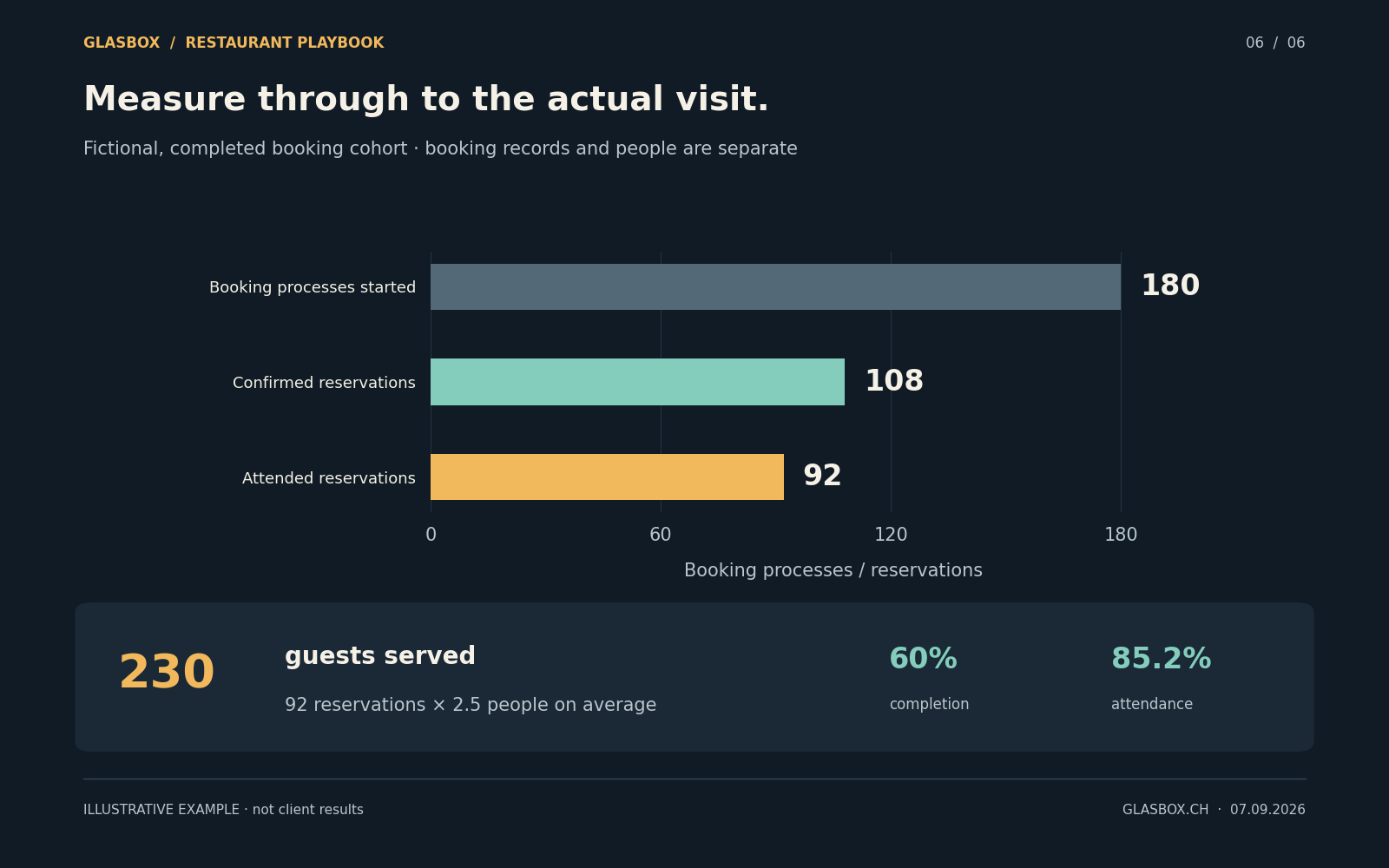
The model completion rate is 108 ÷ 180 = 60%. The attendance rate is 92 ÷ 108 = 85.2%. Both are illustrative values, not targets. A real cohort needs consistent matching and sufficient time for its scheduled visits to occur. Duplicate events or bookings falling into another reporting window would otherwise distort the result.
Technical reconciliation uses only necessary data and permitted matching. Names, email addresses, phone numbers and reservation free text do not belong in Analytics events or URL parameters. Google prohibits sending such personally identifiable information to Analytics.
If external bookings cannot be technically confirmed, we report “booking started” and provide a separate booking-system export. We do not invent a complete funnel. Missing consent, device changes, unrecognised sources and direct visits limit attribution. A voluntary “How did you hear about us?” question can supplement the picture, but remains incomplete too.
16 — Adding Google Ads, Instagram and platforms sensibly
SEO and GEO form part of demand development. A limited offer can also benefit from advertising when the offer fits and the booking journey works. For LUMEN, we would initially limit paid activity to a substantiated occasion and genuinely available capacity.
| Channel | Useful role in the model | Critical check |
|---|---|---|
| Google Search and Maps | Reach existing local dining intent | Correct information and traceable reservations |
| GEO observation | Examine representation in more complex guest questions | Sources, factual accuracy and context |
| Google Ads | Test a specific offer with a separate budget | Costs compared with actual results |
| Instagram and other social channels | Show food, people and a reason to visit | Genuine offer, relevant audience and next step |
| Booking or delivery platforms | Add reach or operational support | Actual contract, fees and incremental value |
| Permitted direct communication | Tell existing guests about relevant offers | Appropriate contact process and voluntary unsubscribe |
An advertising test separates media spend, management and landing-page work. Region, language, message and actual delivery must fit the dining occasion. A local catchment for an immediate lunch is different from a traveller researching before arrival. There is no universally correct radius.
Platform calculations use actual Swiss contract terms. Foreign commission rates are not imported into the model. A direct channel also has costs, including software, payment processing and administration. Moving channels is valuable when it creates a demonstrable economic benefit while respecting the relevant agreements.
17 — When an AI assistant becomes useful
A restaurant does not automatically need a chatbot. If opening hours and menus are frequently missing, those information gaps should be fixed first. A dedicated assistant may become useful when repeated questions about groups, procedures or approved offers create demonstrable work and the restaurant can maintain the knowledge reliably.
A RAG system retrieves information from a defined knowledge base to support an answer. For a restaurant, this could include approved menus, group conditions and current service information. It is a separate system on the restaurant’s website; it does not create preferential recommendations in public AI search.
Live availability and confirmation must come from the responsible booking system. A language model cannot infer a free table from a menu document. Uncertain information, special requests and allergy questions should reach the responsible person at the restaurant. An automatic “guaranteed safe” response would be unacceptable.
Data protection as an operating decision
Before integration, we recommend mapping the data flows: what is entered, where it is processed, which providers receive it, who has access and when it is deleted. Public operating information and personal reservation data need separate processing paths. Swiss hosting alone does not answer these questions.
Implementation must fit Swiss data protection law and any other applicable rules. The FDPIC’s guidance on cookies and similar technologies explains why personalised advertising and intensive profiling require careful assessment. Our technical starting point would activate optional analytics and marketing only after the intended valid permission. A banner does not replace examination of the actual data flows.
An AI assistant, its integrations and recurring provider charges receive a separate proposal. For LUMEN, that investment should be considered after the booking journey, core pages and information maintenance work reliably and a real benefit can be identified.
18 — Frequently asked questions about restaurant SEO and GEO
Does a restaurant in Lucerne need GEO?
It is sensible to check how relevant AI searches describe the business. This may reveal specific information work. A small restaurant with unclear opening hours or a broken booking journey generally has those evidenced tasks to address first. GEO extends a functioning foundation.
How quickly can results appear?
Technical repairs can be checked after implementation. Changes in search and AI answers also depend on external systems. Additional reservations must be observed over appropriate periods. A project’s 30-, 60- or 90-day reviews are checkpoints, not performance guarantees.
Does the entire website need rebuilding?
Only if the audit shows that the existing structure cannot support the required improvements economically. Relevant pages, mobile usability and booking journeys can often be improved selectively. The proposal should explain the reasoning.
Is a PDF menu enough?
A well-produced PDF can be a useful additional option. We recommend also providing essential dishes, prices and validity information in accessible HTML. This makes the menu easier to read on a phone and link to from relevant pages. A PDF is not automatically unindexable.
Can you guarantee a Google position or a ChatGPT recommendation?
No. Investigation, implementation, documented checks and repeat observation can be commissioned. Selection and presentation by search and answer systems remain outside our control. A mention is not necessarily an explicit recommendation either.
Does CHF 18'000 buy the entire annual plan described here?
No. CHF 18'000 is twelve months at the published monthly starting price. The work included in a particular engagement is individually agreed. This detailed annual plan is a planning structure, not a complete fixed-price offer.
Is SOURCE/01 Full compulsory on top of every engagement?
The Full Audit is separately available. The proposal determines which investigation is appropriate and commissioned before or within a specific project. The free preliminary analysis and post-agreement project analysis should not be treated as an automatically added Full Audit charge.
What does GlasBox need from the restaurant?
A decision-making contact, the website, current operating information, priority services and realistic capacity expectations. After commissioning, the agreed role permissions and data follow. Economic assessment requires reliable cost and performance data from the business.
Are the figures real GlasBox results?
No. The restaurant, occupancy, audit findings and numerical examples are fictional. They explain the method. Claims about real client outcomes need verifiable evidence and the necessary permission; this article presents no such results.
How is success assessed after twelve months?
Through delivered and accepted work, more reliable information, functioning reservations and available booking and operating data. The commercial decision considers project costs, incremental contribution and uncertainty about which portion was actually caused by the work.
19 — The next step: put your starting position on the table
A good restaurant deserves a digital presence that makes its quality understandable. Guests should be able to see why a visit fits, what to expect and how to book. Management should understand what it is paying for and how progress will be assessed.
At GlasBox, we begin with your business, your offer and your guests’ questions. The preliminary analysis identifies potentially useful work. Within the commissioned scope, the deeper audit establishes a verifiable baseline. Implementation connects clear content, sound technology and a functioning reservation process.
If you want to prepare the next season more deliberately, bring your website and your three most important operating questions. For example: how can we attract more suitable guests on Tuesdays, reduce repeated questions about company dinners and understand how search and AI answers describe our restaurant?
Turn open questions into a clear working plan.
Discuss with GlasBox which services and dining occasions your restaurant should strengthen. Your individual project proposal includes a free preliminary analysis. Scope, budget and acceptance criteria are agreed transparently.
Discuss your restaurant project20 — Sources and editorial transparency
The linked primary sources explain platform functions and policies. Offer-specific information was checked against GlasBox’s published pages on 7 September 2026. Platforms, scope and prices can change; the current individual proposal is authoritative.
Double Digital’s “Reklama restauracji” article provided an editorial starting point for the subject of economically grounded restaurant marketing. This GlasBox guide is an independent treatment for Switzerland. Polish market figures, platform commissions and legal statements were not adopted as Swiss facts.
All graphics containing operating figures, findings or observation rates are labelled as illustrative or fictional. The roadmap is a proposed sequence. No restaurant was live-audited for this article, and none of the illustrated AI test runs were performed. The cover does not document a client venue. The annual plan and sample scope create no binding commitment regarding delivery, results or compliance.