
Your business appears in an AI answer, alongside several links. Is your website a source? Has the system understood your service correctly? Does the answer help a suitable customer make a decision? These questions go further than looking for your company name. Part 5 explains how expertise becomes a useful public source, and how to check a visible citation.
By Kacper Ruta · GlasBox Studio, Malters/Lucerne · Reviewed 19 October 2026.
Part 4 covered RAG with approved organisational knowledge. We now turn to public AI search, where the provider decides which information to retrieve, process and display as a link. You control your content and its publication; selection in another system’s answer remains outside your control.
A mention, a source link and a recommendation describe different observations.
Expertise, real examples and clear limits make a page useful to customers.
Open the link and compare the specific claim with the original source.
01 — Mentions and citations: what can you actually see?
A mention is a reference to a company, person or product by name in the answer. A citation, as used here, is a displayed source reference attached to a passage or its accompanying source list. Both can occur together. For our own review, we therefore record the brand name separately from the link destination.
| Visible situation | What you can record | What it does not yet establish |
|---|---|---|
| Company name without a link to its website | The brand is mentioned. | Its website was retrieved for this answer. |
| Link to your service page | Your URL is displayed as a source. | The whole answer passage is correct. |
| Link to a third-party article about the company | Another site receives the source link. | Someone has visited your own website. |
| Company name and its own source link | Both a mention and a direct source reference are visible. | An enquiry or preferred recommendation has resulted. |
Our fictional example is a window-cleaning business in the Lucerne region. If an answer names it, that is initially a mention. If it links to a trade directory, the directory is the visible source. Only an actual displayed link to the company website is a direct source reference to that site. These working definitions help with recording observations; they are not a universal reporting standard shared by all platforms.
Review rule: A citation provides a route to verification. It is neither a quality seal for the business nor automatic confirmation of the answer.
02 — Grounding connects an answer to external information
Grounding connects an answer to information beyond the model’s stored knowledge, such as search results, supplied documents or data from a connected system. RAG is one technical approach. Part 4 explained how to build a governed RAG system; here we focus on what can be observed in a public answer.
The Gemini API documents one possible workflow: with its search tool enabled, the model assesses whether search would help, issues queries when needed and processes the results. Citations can connect answer passages to retrieved pages. This describes that API capability, not automatically every mode of the Gemini app. [3]
A year, a location or a request for sources can clarify the information need. None is a reliable switch that forces a web search. An absent link does not prove that no retrieval occurred either. Conversely, a model can produce a URL without a verified current retrieval. Observe the search indicator and open the sources rather than guessing the internal process from fluent wording.

Visible source lists are only a partial view. They reveal neither every document considered nor a complete scoring process. “The AI trusted us” therefore claims more than “Our URL was displayed here as a source.” A sound case description uses the second, verifiable wording.
03 — Query fan-out: one question contains several tasks
Google describes query fan-out as splitting a question into related subtopics and running searches in parallel. This can supply material for different aspects of an answer. It does not mean that every product asks the same subquestions or that a visible progress indicator exposes the complete search process. [4]
Our example question: “Which window-cleaning service in Lucerne suits a property manager with several buildings, and what should we check in the quotation and acceptance?”

| Customer subquestion | Useful information on the website | Appropriate location |
|---|---|---|
| Does the business cover our area? | Actual service area and contact details | Service page or contact page |
| What does cleaning include? | Glass, frames, exclusions and preparation | Clear scope section |
| How are hard-to-reach surfaces assessed? | Site-visit process and technical limits | Working-method section |
| How can quotations be compared? | Included work, prerequisites and open items | Quotation explanation |
| How is the work accepted? | Review points and follow-up procedure | Documented project process |
This table is a content plan, not a request for five automatically generated landing pages. One good service page with coherent sections and a deeper practical article may be enough. A separate page earns its place when it serves a distinct task and has enough substance of its own. The underlying commitment should remain consistent across languages.
04 — From topic to prompt: begin with customer questions
A broad topic such as “window cleaning” is too vague for an editorial brief. A specific situation makes it actionable: who is asking, what decision is pending, what remains unclear and what evidence would help? The demanding creative work is discovering these situations in conversation and explaining them with technical precision.
| Situation | Natural question | Editorial task |
|---|---|---|
| Initial orientation | What distinguishes routine from intensive cleaning? | Explain terms and boundaries with an original example. |
| Comparing quotations | Why do two offers for the same property differ? | Make scope, accessibility and assumptions visible. |
| Project preparation | What information is needed before a site visit? | Create a short preparation guide that people can actually use. |
| Decision | How is completion of the work recorded? | Explain the business’s acceptance process. |
Gather language from initial conversations, follow-up questions and quotations, respecting confidentiality. A technical term may be accurate even when customers phrase the issue differently. A good page connects both: it answers the natural question and introduces the useful term. There is no need to turn every heading into a question or repeat the same phrase throughout.
Start prioritisation with a reasoned order: which question often blocks a suitable enquiry? Where is a mistaken expectation costly? Where can we contribute reliable first-hand knowledge? Without demand or monitoring data, call this selection an editorial hypothesis rather than a measured market opportunity.
05 — Specialisation supplies the substance; creativity makes it clear
Many pages describe a business as “professional, reliable and tailored.” That leaves out the information needed to compare it. The useful story often begins with an exception: which surface needs different treatment? When is a site visit necessary? Which request would you decline? Someone who understands the work can answer these questions.
Google identifies first-hand experience and original contributions as characteristics of helpful content. Our editorial practice turns that into a concrete task: speak to the person doing the work, find a detail that needs explaining and choose the simplest format to show it. The creative contribution lies in selection and presentation, not in producing the most paragraphs. [6]
An example editorial brief
Fictional brief: explain why quotations for the same glass area can differ. A specialist interview identifies the factors: access, soiling, included frame cleaning, working hours and acceptance. The result is a clear comparison table, an annotated original photograph and a short explanation of the site-visit process. It needs neither invented prices nor a blanket claim that the company’s own offer is always better.
Which information prevented a mistaken assumption on the last project?
Which work step would an original photograph explain better?
Which limitation belongs beside the benefit?
Who can approve the technical statement and keep it current?
Text, images and video should describe the same reality. A photograph of another method does not become evidence through a convenient filename. Captions and alternative text describe what is actually shown. Explanatory diagrams are labelled as models; measured numbers identify their source, period and scope. That lets a customer distinguish an illustration from evidence.
06 — A useful source connects a claim, its evidence and its limits
Imagine someone arriving halfway down your page through a source link. Can that person immediately find the relevant claim, its scope and its evidence? A standalone “up to 40 per cent faster” is hard to interpret. Method, baseline, period and limitations make such a number reviewable. If those data are missing, we do not publish the number.
| Component | Editorial review question | Example without a performance promise |
|---|---|---|
| Clear claim | What exactly is being explained? | The work included in a quotation. |
| Scope | For whom and under which conditions? | The described job and its prerequisites. |
| Evidence | What can the reader inspect? | Approved photograph, service description or documented process. |
| Responsibility | Who knows and maintains the information? | A named specialist with a real role. |
| Limit | What remains open or excluded? | Access and unusual soiling are assessed separately. |
A company’s own statements and independent confirmation play different roles. Its website is the right place for its service scope. A verifiable third-party report can add another perspective. Presenting a paid or invented recommendation as independent evidence would undermine the trust that the page is meant to build.
Structured data must also match the visible page. Markup should describe existing information, not invent qualifications, ratings or achievements. Syntactically correct schema is neither evidence for the claim nor an entitlement to display. [8]
07 — Technical discoverability and editorial quality work together
To be eligible as a supporting link in Google AI Overviews or AI Mode, a page must be indexed and eligible to appear in Search with a snippet. Google does not specify a special additional GEO label. Check accessibility, internal links, visible text and actual indexing. Meeting a prerequisite does not guarantee selection. [1]
Google’s guidance warns against manufacturing pages for every possible subquestion. It requires neither a fixed text length, artificially small “AI chunks” nor a special llms.txt file for these Search features. Use coherent sections because people can understand and locate them. The mechanics of a private RAG index are not a universal writing specification. [2]
The important explanation is readable text on an accessible page.
Meaningful internal links lead to that page.
Language, company name, contact details and service scope are consistent.
Images explain the real subject; captions contain no invented evidence.
Outdated claims are corrected rather than merely given a new visible date.
08 — Why a source link still needs checking
A historical study by Liu, Zhang and Liang evaluated four generative search services in 2023: Bing Chat, NeevaAI, Perplexity and YouChat. On average, 51.5 per cent of generated sentences were fully supported by citations; 74.5 per cent of citations supported their associated sentence. These measures have different denominators. [7]

| Study metric | Value | Denominator |
|---|---|---|
| Citation recall | 51.5% | Generated sentences fully supported by citations. |
| Citation precision | 74.5% | Citations supporting their associated sentence. |
These figures measure neither current Gemini or Google AI Mode quality nor the Swiss market. Their value here is the review method: the answer passage and source must agree. Claims about present-day systems would need a new, documented evaluation.
Three questions when opening the source
Does the linked page support the actual claim, or merely discuss a related topic?
Does the information apply to the stated location, period and use case?
Has the answer omitted a condition, exception or uncertainty?
09 — Gemini and Google AI Mode: four real answer excerpts
The following four captures were supplied for this article. The contributor confirmed their attribution to Gemini and Google AI Mode. The questions refer to Lucerne; capture time, actual test location and model version are not documented in the excerpts. We therefore describe the visible answers without treating them as a general ranking of the products.
Question 1: what belongs in the quotation?
German prompt: “Welche Angaben sollte eine Offerte für Fensterreinigung bei einer Liegenschaftsverwaltung in Luzern enthalten? Berücksichtige Leistungsumfang, Zugänglichkeit, mögliche Zusatzarbeiten und Abnahme. Bitte verlinke die Quellen zu deinen Angaben.”

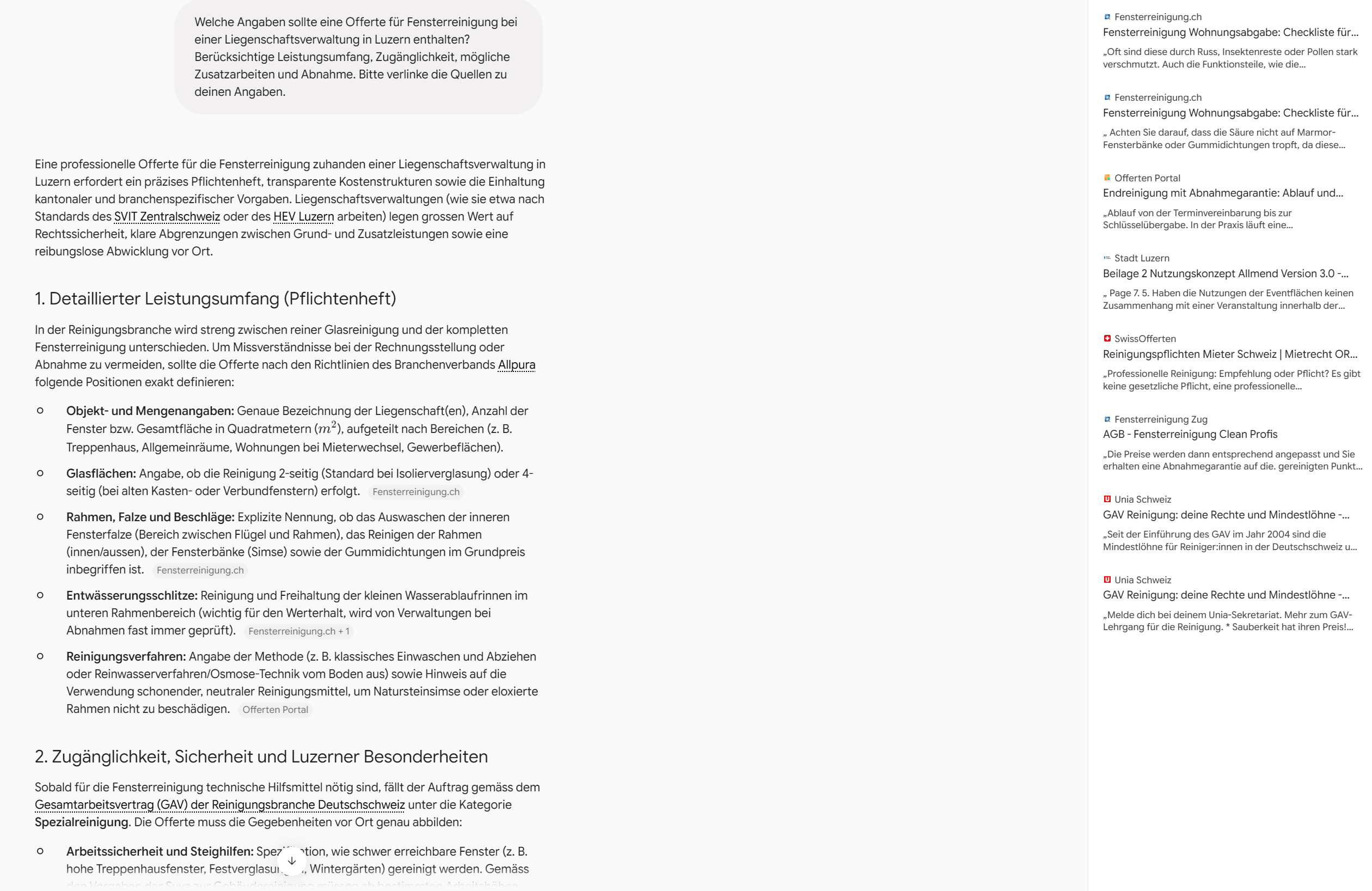

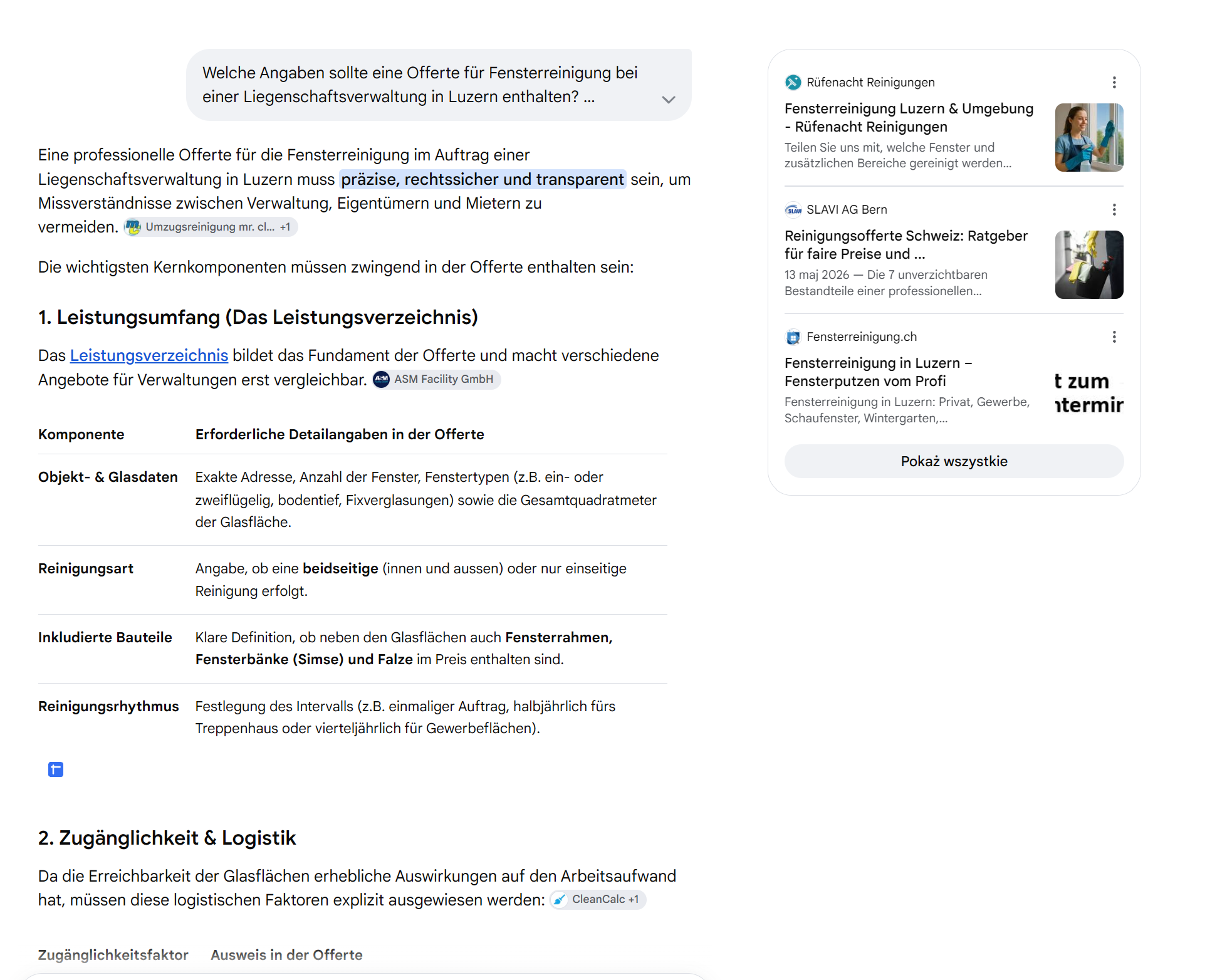
Both excerpts organise the answer around scope and access. They display different source entries and presentation formats. We can observe the names and source indicators shown, but the images alone do not let us check the full destination URLs or whether every individual claim is supported.
Phrases such as “legally sound” and statements about supposedly mandatory requirements belong to the captured AI answers. The capture does not confirm their technical or legal accuracy. Checking them would require opening the specific original source and comparing it with the claim.
Question 2: which providers are considered?
Visible core of the German question: “Welche Anbieter für Fensterreinigung in der Region Luzern kommen für eine Liegenschaftsverwaltung mit mehreren Objekten infrage?” The full prompt is collapsed or cut off in the excerpts.

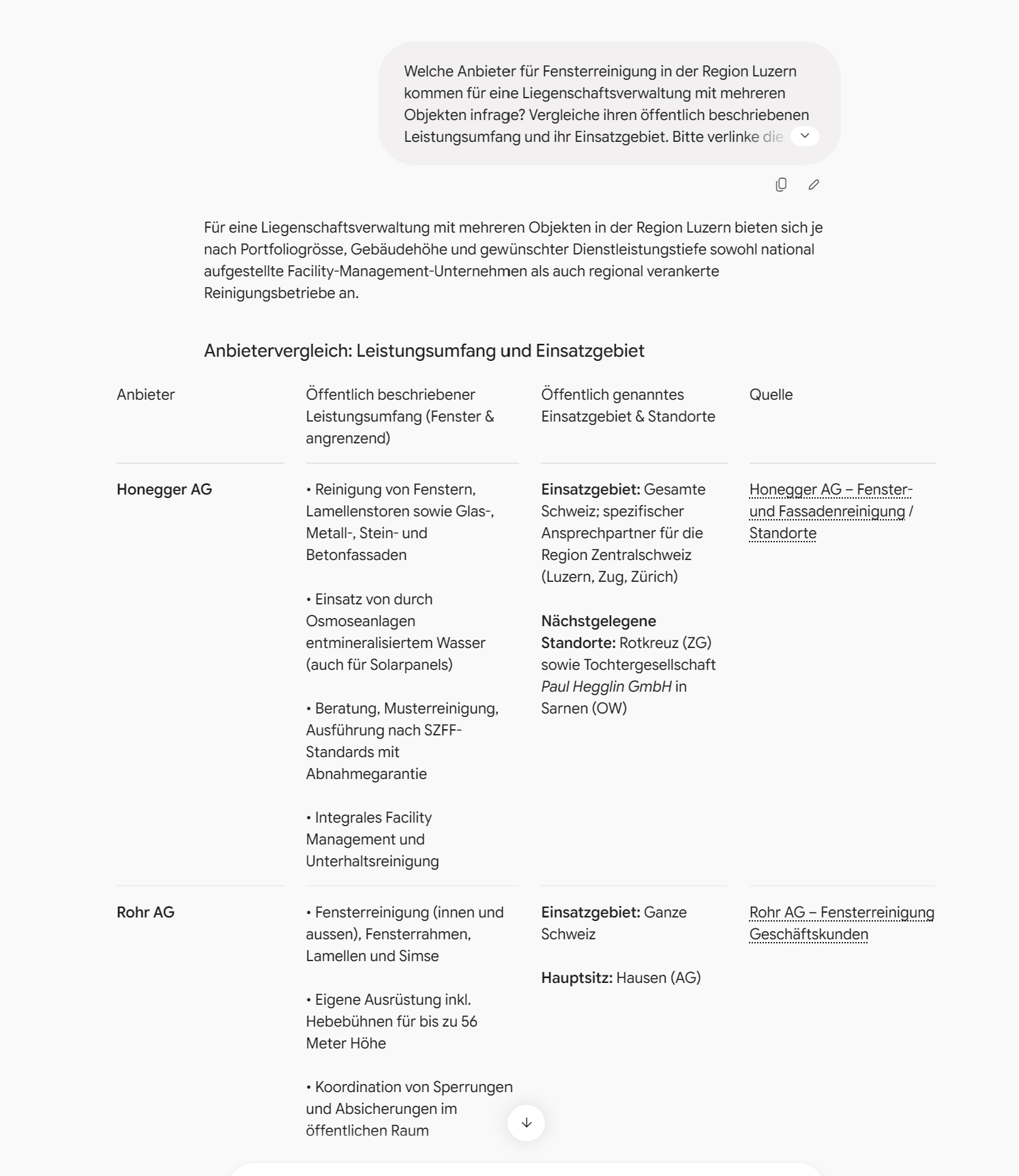

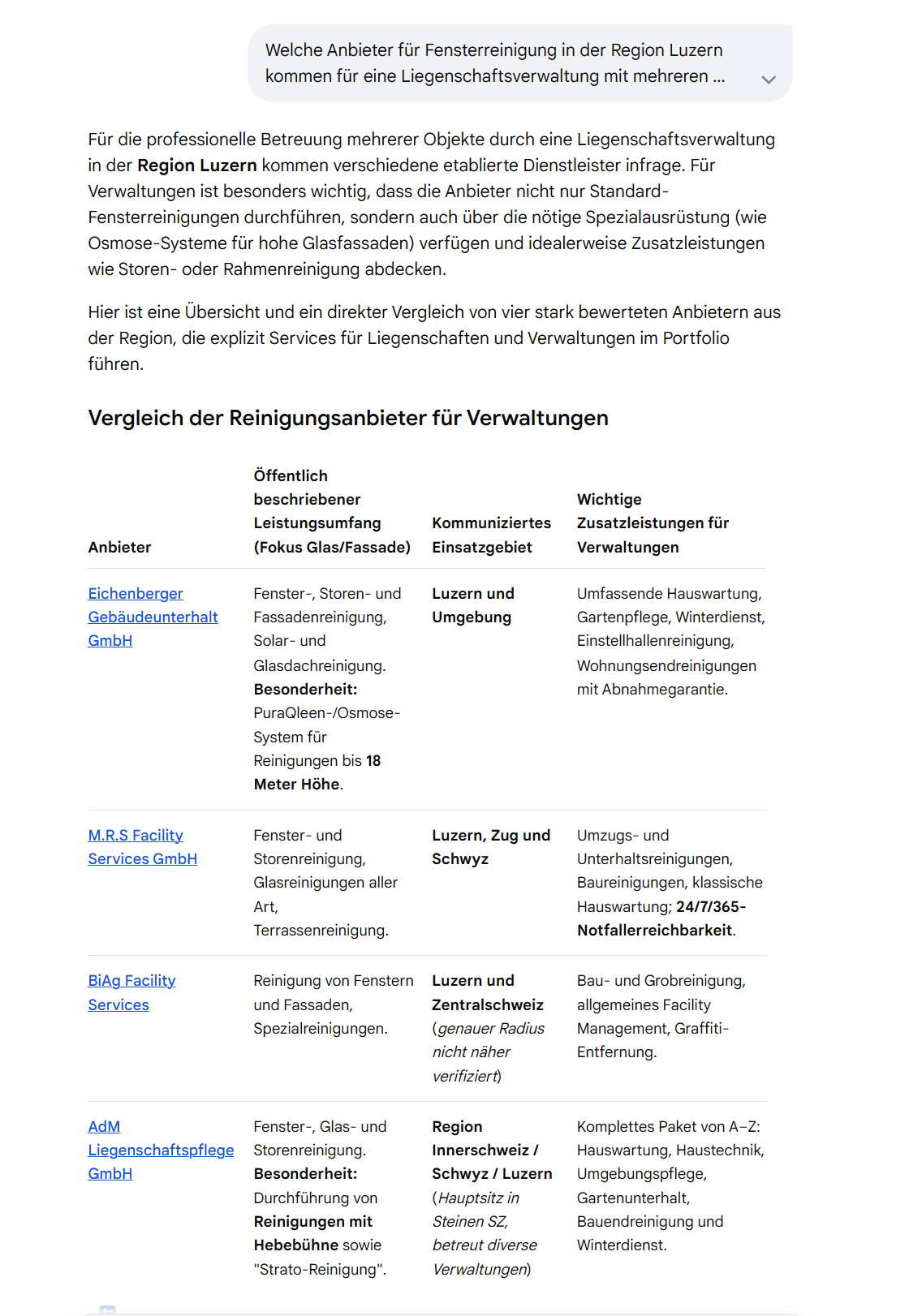
The Gemini excerpt visibly names Honegger and Rohr, among others. Google shows Eichenberger, M.R.S Facility Services, BiAg and AdM, among others. This illustrates different visible provider selections. It establishes neither complete market coverage nor the quality of those businesses. These captures are not GlasBox provider recommendations.
The distinction helps explain mentions and citations: a company name in the answer is a mention; a visible source reference is an additional observation. Only the actual link reveals whether it leads to the company’s domain or a third party, and whether it supports the claim. Gemini’s own documentation says that its app can also display related content. [5]
None of these captures exposes a complete query fan-out. Nor does it show a persistent ranking, a trend over time or a resulting enquiry. Those questions need a documented, repeatable measurement procedure, which is the subject of Part 6.
10 — From a source link to a suitable enquiry
Even a correctly cited page can leave the business question unresolved. After clicking, a visitor should understand the offer, whom it suits and what information is needed next. A useful explanation can lead to a conversation without repeating the same sales prompt throughout the article.
| Observation | Defensible statement | Still needs separate evidence |
|---|---|---|
| Brand name in an answer | A mention was documented. | Recurring visibility. |
| Your URL displayed as a source | A direct source reference was documented. | Clicks and visits. |
| Visit with an identifiable AI referrer | An attributable website visit was recorded. | Whether it led to a suitable enquiry. |
| Qualified enquiry with traceable origin | A business contact was recorded. | The causal contribution of specific content and its long-term effect. |
Bing’s AI Performance report provides a first-party view of citations across supported AI surfaces. That source activity is neither a universal ranking score nor a revenue measure. Part 6 will build on this distinction with metrics, repeatable observation and the connection to enquiries. [9]
11 — The next editorial task: improve one page with substance
Choose a common question that precedes a suitable enquiry. Review the existing page and identify what a customer still needs to know. Obtain that knowledge from the responsible specialist. Add reviewable evidence and the most important limitation. Then decide whether a table, photograph or diagram genuinely helps.
At GlasBox, this is where SEO, GEO and content meet: understand customer questions, uncover specialist knowledge, develop an original explanation and check the technical publication. The immediate result is a better information resource. Whether and where another AI system uses it is observed afterwards.
The principle from Part 5: A strong source first helps people understand and decide. If it appears in an AI answer, its claim must still stand up after the click.
How technical work, specialisation and creative content work together.
12 — Common questions about sources in AI answers
Can a brand have both a mention and a citation?
Yes. A company name can appear in the answer while a source link leads to its website. Record the two observations separately so that mentions and destination URLs are not confused.
Does grounding guarantee a correct answer?
No. Retrieved information can be irrelevant, outdated or misrepresented. A source link makes verification possible; it does not replace it.
Does every possible subquestion need its own page?
No. A page needs a distinct purpose and enough original substance. Several related questions can be answered on one coherent page.
Is a screenshot evidence of GEO growth?
It records one answer under documented conditions. A growth trend requires repeated measurements using a comparable procedure.
Which matters more: technical or creative work?
A page must be accessible and provide useful information. Specialist research, original examples and clear presentation give that technical foundation its substance. Both are guided by the customer’s actual question.
Sources and editorial basis
Reviewed 19 October 2026. Text and concept graphics are original GlasBox explanations. Technical descriptions were checked against the primary sources below. Editorial task examples are fictional; section 9 shows actual supplied screen captures within the stated observational limits. Only the explicitly historical study chart contains external measured data.
Eligibility for supporting links, response variability and foundational SEO.
Original content and limits of mass-produced pages, artificial chunking and special GEO files.
Search tool, conditional retrieval and source references in the Gemini API.
Vendor description of query fan-out, not a trace of an individual search run.
App sources and related links; not every answer includes sources.
First-hand experience, originality and accountable content.
Historical primary study: 51.5% citation recall and 74.5% citation precision; DOI 10.18653/v1/2023.findings-emnlp.467.
Visible content and markup must agree; display is not guaranteed.
Citations across supported AI surfaces; source activity is not a ranking or revenue measure.
Which customer question does your website still leave unanswered?
In an initial conversation we review one page, its message and the available evidence. Together we identify where specialist, creative or technical work would help.
Request an initial conversation