Generative Engine Optimization (GEO) adds observation of generated answers to work on an understandable, discoverable website. Clear services, checkable sources, appropriate languages and technical access are useful work areas for Swiss B2B brands. BLUF, structured data and a 90-day plan can organise implementation; llms.txt is an optional directory, not a Google visibility requirement.
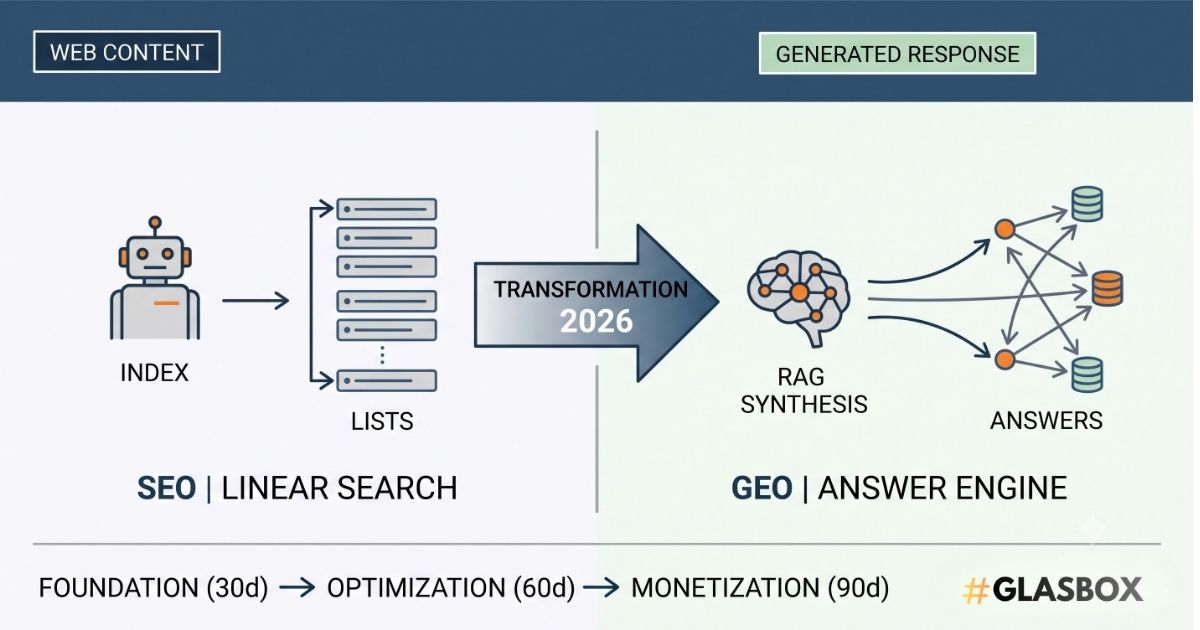
What GEO really means in 2026
Classic SEO examines discoverability, queries and clicks, among other measures. GEO adds mentions, source links and accuracy in generated answers. These review areas are related. The statement selected depends on the platform and search context; we do not claim a universal ranking formula.
For Swiss B2B companies, this matters because many buying journeys now happen before the first sales conversation. CFOs, CMOs and CTOs research vendors, risks, costs and alternatives in search engines, specialist sources and increasingly AI systems. When GlasBox prepares a website for GEO, the work is not just more content. It is a machine-readable knowledge system.
The three core goals of GEO
Citeability: key claims must be concise, unambiguous and defensible.
Entity clarity: search engines and LLMs must understand who the brand is, where it is based, what it offers and who it serves.
Context density: content must include enough Swiss, technical and commercial signals to match local B2B queries.
BLUF: make the opening useful for readers
BLUF places the main statement first. It can help readers understand the topic quickly. Later sections provide reasoning, examples and limits. It is an editorial method, not a prescribed ideal section length or a demonstrated guarantee of preferred AI citation.
- A strong BLUF paragraph answers four questions in 3 to 5 sentences: what is it, who is it for, why now and what should happen next?
- Every H2 should answer a standalone question or decision.
- Sections should contain compact fact blocks instead of loose marketing narrative.
- Numbers should be framed as internal benchmarks, project targets or clearly qualified assumptions when no external source is provided.
llms.txt as an optional directory
llms.txt is a proposal for a compact directory of background information and links. It replaces neither a sitemap nor HTML. Google explicitly states that it does not use llms.txt for search visibility. Other services may use these directories; any particular benefit needs evidence for that service.
GlasBox maintains services, company identity and key articles there as supplementary guidance. The information must agree with the website and be delivered as valid UTF-8. We do not infer a higher mention probability from the file’s existence.
GlasBox SEO and GEO for Swiss companies
JSON-LD: describe visible facts accurately
BlogPosting, Organization and BreadcrumbList can describe content and relationships in structured form. Choose types for the actual content. Author, date, language and operator should match visible details. There is no special mandatory Google GEO markup; missing schema alone does not prove missing AI visibility.
Shows that GlasBox Studio is a Swiss B2B agency based in Malters, Lucerne, not a generic glassware or product brand.
Connects headline, date, author, publisher, URL and language into a citeable article object.
FAQPage describes visible questions and answers. It replaces neither useful copy nor other requirements and is not a special GEO prerequisite.
Swiss GEO needs local context density
Swiss B2B buyers need relevant information about coverage, language, operator and actual terms. An identifiable address, UID and local examples can aid verification. They are not general bonus factors for AI answers. Privacy information should describe the actual data flow rather than rely on origin labels.
Use DE-CH writing where relevant: no Eszett, Swiss terms and no automatic Germany-flavoured translation.
Mention places and regions only when they reflect the actual location or service area.
Keep trust data consistent: brand, operator, UID, address, phone, email and contact page.
Frame privacy realistically: conscious, compliance-oriented and dependent on the concrete setup.
The GlasBox 90-day GEO framework
| Phase | Goal | Deliverable |
|---|---|---|
| Day 1-30 | AI Visibility Audit and technical foundation | Question set, indexing review, content inventory, appropriate structured data; optional information directory |
| Day 31-60 | Content engineering and entity clarity | BLUF pages, FAQ blocks, internal links, service clusters, structured data |
| Day 61-90 | Authority, measurement and iteration | Tier-2 signals, comparison pages, tracking setup, AI citation monitoring |
Suggested working framework, adapted to scope and starting position. Acceptance covers agreed work; mentions and business outcomes are observed.
Which pages should be optimized first
- Homepage: clear brand definition, audience, location, offers and proof.
- SEO/GEO page: methodology, concrete services, cost logic, FAQ and internal links.
- AI page: use cases, privacy, RAG, automation and limitations.
- Contact page: intent-led enquiry options and clear next steps.
- Blog articles: deep topic clusters with BLUF, FAQ and citeable short answers.
How GlasBox builds AI automation and RAG for Swiss SMEs
Measurement: what GEO teams should monitor
GEO measurement is less standardized than SEO measurement. That is exactly why it needs clear internal rules. GlasBox uses repeatable prompt sets, AI visibility snapshots, logic for branded and non-branded queries, Search Console data, indexability checks and manual quality review of generated answers.
Is the brand mentioned for relevant prompts?
Is the description accurate or does the system hallucinate services?
Which URL is cited or recommended?
Do Swiss local signals appear in the answer?
Are contact quality, enquiries and topical authority improving?
Conclusion: GEO is not a plugin, it is an operating system for visibility
GEO combines technical review, understandable content and repeated observation. Its value comes from accurate information and better decisions, not a guaranteed model response. Start with commercially relevant questions and document the baseline before claiming impact.
Kacper Ruta · owner of Ruta Group · GLASBOX Studio
Accepting a 90-day work package
Working example without an outcome promise: a DE and EN service page receive the same approved scope, current prices and clear enquiry paths. Technical acceptance checks HTTP, canonical URLs and language switching. Editorial acceptance compares statements with the proposal. Only then are the same AI questions repeated. This distinguishes completed work from observed effects.
Audit your AI visibility?
GlasBox analyzes how well your brand is prepared for ChatGPT, Perplexity, Gemini, Copilot and Google AI answers - technically, editorially and locally for Switzerland.
Request GEO audit