In 2026, chatbot is no longer a nice-to-have. For Swiss SMEs, a properly built AI chatbot is an operational layer that reduces support load, increases lead quality, and standardizes knowledge across the company — if implemented with governance, safe data handling, and measurable KPIs.
Clear stance: a generic LLM with no company context is not a business asset. The value comes from grounding the bot in your content (RAG), connecting it to your tools (CRM, tickets, calendar), and enforcing strict guardrails.
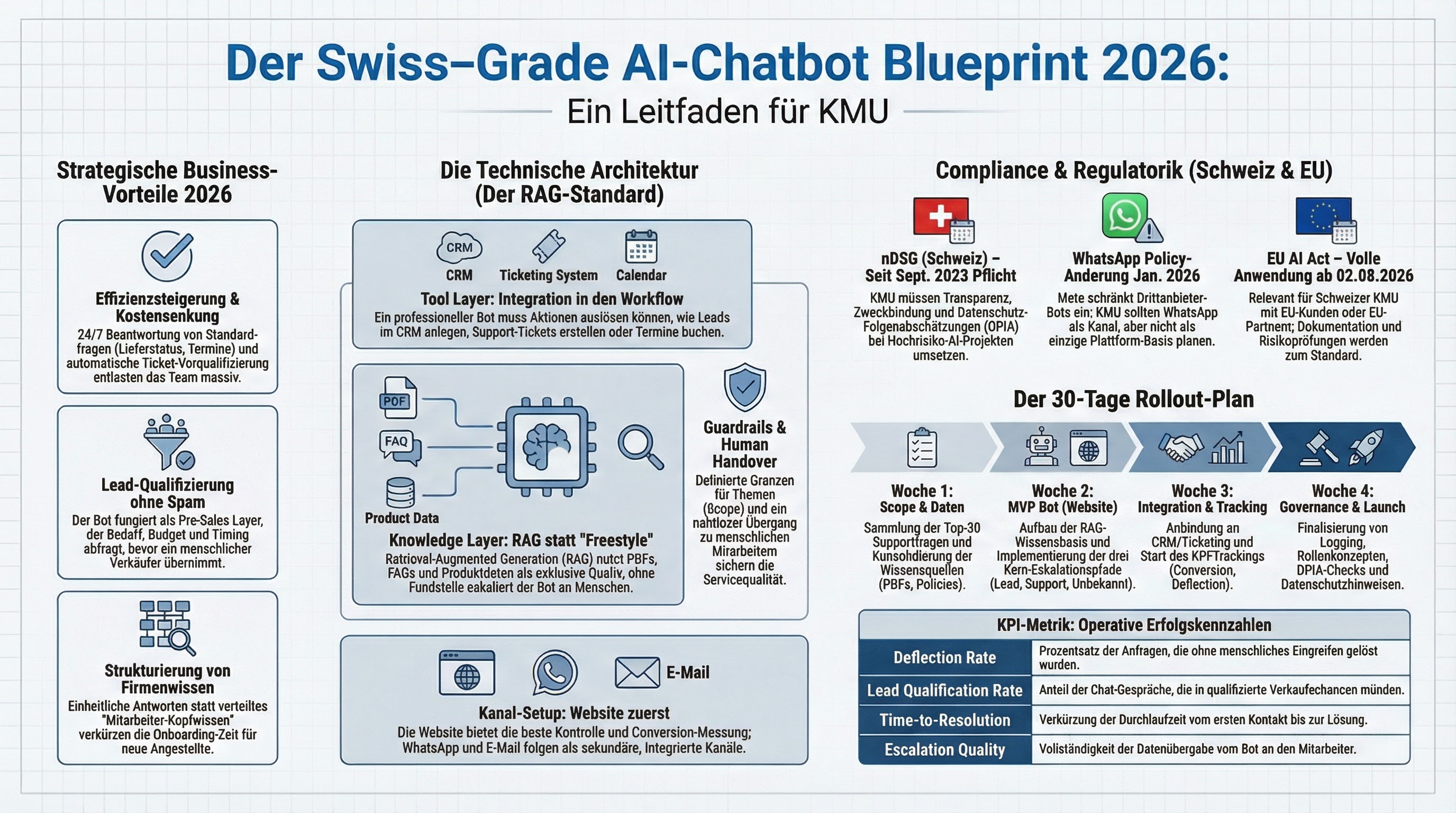
What SMEs actually get — when done right
24/7 answers to repetitive requests. Triage and structured handover to humans — less ping-pong and fewer dropped queries.
The bot asks the right questions (budget, timeline, requirements) and drives a clear next step: call, meeting, or quote request.
One source of truth for product and service answers. Faster onboarding and fewer tribal knowledge gaps. A bot that does not fill your CRM or create tickets is a marketing gimmick.
How a professional AI chatbot works — 2026 architecture
1) Channel strategy: website first
Website chat first: highest control and best analytics
Email and forms second: triage and drafts
WhatsApp where it makes sense — but not as your only channel (policy reality below)
2) Knowledge layer: RAG over free improvisation
Modern bots use Retrieval-Augmented Generation (RAG): index your approved content (FAQ, PDFs, policies, service pages), generate answers only when grounded in retrieved sources. If sources are missing: I do not know + escalation. This is the difference between looks smart and operationally safe.
3) Tool layer: the bot must take action
Create and update CRM leads automatically
Open tickets with category and priority
Suggest and book appointments
Pull order and return status for e-commerce
Create call-back tasks for your team
4) Guardrails and human handover
Hard scope boundaries: define what the bot can and cannot do
PII and sensitive-topic handling rules
Human takeover as a designed flow, not an emergency
Compliance in Switzerland — and why EU rules still matter
Swiss companies must comply with transparency, purpose limitation and appropriate technical safeguards. For high-risk AI processing, Swiss guidance highlights the need for a data protection impact assessment (DPIA).
Swiss SMEs should care if they serve EU customers or operate through EU partners. Documentation, transparency and risk reviews are the core obligations.
Switzerland is not copying the EU AI Act. It moves via sector-specific updates and intends to ratify the Council of Europe AI Convention. A significant competitive advantage for Swiss startups.
Operational takeaway: build nFADP-compliant now, and design for AI-Act readiness to avoid expensive rebuilds later.
WhatsApp in 2026: powerful, but do not bet the company on it
WhatsApp remains a strong service channel, but policy changes taking effect 15 January 2026 restrict certain third-party general-purpose AI chatbots on the platform. What this means for SMEs:
Use WhatsApp mainly for customer service workflows: status, appointments, FAQs
Keep the bot brain channel-agnostic
Treat WhatsApp as one channel, not your platform foundation
A 30-day rollout plan — no overengineering
Extract top 30 customer questions from support, calls and inbox. Consolidate and approve source content (FAQ, PDFs, policies).
Build RAG knowledge base. Implement three flows: lead, support, unknown to human handover.
Minimal CRM and ticketing integration. KPI instrumentation: conversion, deflection, escalation quality.
Logging, review process and permissions. DPIA check if needed, updated privacy notices, retention and deletion concept.
KPIs that matter
Measure these from week 3. Without measurement there is no proof — and no budget for phase 2.
FAQ
Do Swiss SMEs really need an AI chatbot in 2026? If you handle repetitive inbound questions or want consistent lead qualification — yes. Otherwise postpone intentionally.
Is Swiss data protection a blocker? No. It is a blueprint: transparency, purpose limitation, safeguards, DPIA for high-risk cases.
Should WhatsApp be the main channel? Not as the only one. 2026 policy risk is real — build channel-independent.
Kacper Ruta — CEO GlasBox Studio / Ruta Group, Malters (Lucerne)
Swiss-grade AI chatbot for your SME?
We build it as a transparent operational platform: measurable, maintainable, compliance-ready. Swiss hosting, FADP compliant, no vendor lock-in.
Request free consultation